Best time to visit Iceland: month by month, with what runs when
The best time to visit Iceland is June to August for long days, mild weather and wildlife, or February and March for the northern lights and ice caves with more daylight than mid-winter. Avoid planning a short trip around one weather-dependent tour in November to January: days are 4 to 7 hours long and storms cancel tours.
By the Iceland Things to Do editorial team · Updated 25 Nov 2026 · Facts checked 25 Nov 2026
On this page
Month by month
- January GoodAurora season and all ice caves open; about 5 hours of daylight and the stormiest weather of the year, so allow spare days.
- February GreatDark nights for the aurora, every natural ice cave running and over 8 hours of daylight by mid-month.
- March GreatThe last full ice-cave month, aurora nights and almost 12 hours of daylight; fewer windy days than mid-winter.
- April GoodLong days return (15 hours), puffins arrive late in the month; the aurora and natural caves end during April.
- May Good18 hours of daylight, Jökulsárlón boats start and puffins are nesting. No aurora: the nights are too light.
- June GreatMidnight sun (about 21 hours of daylight), the calmest weather in our data, puffins and whales. No aurora.
- July GreatWarmest month (about 13 °C by day), long days, whales and puffins.
- August GreatStill warm with long days; puffins leave mid-month and dark nights return late in the month.
- September GoodAurora season starts, fewer crowds, 13 hours of daylight, but rain days rise.
- October GoodAurora nights, the natural ice caves open, autumn colours; Jökulsárlón boats are ending.
- November PossibleAurora and ice caves, but under 7 hours of daylight and frequent winter storms.
- December PossibleAbout 4 hours of daylight, aurora and ice caves; plan around storms and the short opening hours on 24 and 31 December.
What runs when
The northern lights season runs from September to April 1. Natural ice caves in Vatnajökull open on 1 October and close on 15 to 30 April for 2026–2027; Katla and the Langjökull tunnel run all year 2. Puffins are off Reykjavík from late April to mid-August 3. Whales are best from April to September 5, though Reykjavík trips run all year 6. Jökulsárlón boats run from May to October or mid-November 4.
What you can do in Iceland depends on the month: the northern lights need the dark nights of September to April, natural ice caves run from about October to April, and puffins nest from late April to mid-August.
Daylight
| Jan | Feb | Mar | Apr | May | Jun | Jul | Aug | Sep | Oct | Nov | Dec | |
|---|---|---|---|---|---|---|---|---|---|---|---|---|
| Daylight in Reykjavík (15th) | 5:21 | 8:34 | 11:38 | 15:01 | 18:20 | 21:02 | 19:48 | 16:29 | 13:08 | 9:54 | 6:34 | 4:14 |
Hours and minutes from sunrise to sunset on the 15th of each month 7. At the winter solstice there are 4 hours 7 minutes of daylight 8; at the summer solstice, about 21 hours 9.
Weather, month by month
Monthly averages for Reykjavík, 2016 to 2025. Expect wind more than cold: the windy-day count is the best guide to how often a tour may be cancelled.
Monthly averages from reanalysis and satellite data. NOAA OISST v2.1 satellite analysis, 2016-2025, sea grid cell in Faxaflói bay, about 9 km from Reykjavík.
Monthly averages from reanalysis and satellite data. NASA POWER (MERRA-2 reanalysis), 2016-2025, grid cell that contains Reykjavík.
Monthly averages from reanalysis and satellite data. NASA POWER (MERRA-2 reanalysis), 2016-2025, grid cell that contains Reykjavík.
Monthly averages from reanalysis and satellite data. NASA POWER (MERRA-2 reanalysis), 2016-2025, grid cell that contains Reykjavík. A rough guide to choppy-sea days, not an operator statistic.
Monthly averages from reanalysis and satellite data. Our calculation of sunrise to sunset with NOAA's solar equations.
Monthly averages from reanalysis and satellite data. NASA POWER (MERRA-2 reanalysis), 2016-2025, grid cell that contains Reykjavík. Estimated from solar radiation, so a guide only.
Show the data as a table
| Month | Sea °C | Air max °C | Air min °C | Rain days | Rain mm | Sun h/day | Windy days |
|---|---|---|---|---|---|---|---|
| January | 4.8 | 1.0 | -2.8 | 20.0 | 162 | 0.7 | 18.2 |
| February | 4.5 | 1.8 | -1.9 | 19.1 | 158 | 1.5 | 16.0 |
| March | 4.7 | 2.5 | -1.4 | 18.8 | 141 | 4.8 | 11.7 |
| April | 5.7 | 5.6 | 1.2 | 17.0 | 115 | 7.3 | 10.1 |
| May | 7.7 | 8.4 | 3.9 | 17.8 | 118 | 7.9 | 6.8 |
| June | 9.7 | 11.1 | 6.4 | 17.0 | 95 | 7.2 | 2.5 |
| July | 11.3 | 13.4 | 8.6 | 16.8 | 94 | 6.4 | 1.3 |
| August | 11.7 | 13.0 | 8.3 | 16.1 | 115 | 5.8 | 1.6 |
| September | 10.4 | 10.0 | 5.8 | 19.6 | 158 | 4.0 | 5.6 |
| October | 8.5 | 6.2 | 2.9 | 20.3 | 151 | 2.5 | 8.3 |
| November | 7.0 | 3.2 | 0.2 | 17.6 | 126 | 1.1 | 9.8 |
| December | 5.6 | 1.4 | -1.8 | 19.1 | 141 | 0.6 | 14.4 |
Air temperature, rain, sunshine and wind: NASA POWER daily data (MERRA-2 reanalysis; CERES/GEWEX solar), 2016-2025, 0.5° × 0.625° cell centred on 64.0 N 21.875 W, which contains Reykjavík and the bay around it. Sea: NOAA OISST v2.1 daily sea surface temperature (satellite and in-situ analysis), 2016-2025, 0.25° cell at 64.125 N, 22.125 W, about 9 km from Reykjavík. Rain days: 1 mm or more. Windy days: days when the strongest hourly mean wind at 10 m reaches 30 km/h. Sunshine: hours of bright sun per day, estimated from NASA POWER solar radiation with the FAO-56 Ångström formula. NASA POWER and NOAA OISST are US government data, free of copyright restrictions. NASA POWER data are provided by the NASA Langley Research Center POWER Project, funded through the NASA Earth Science Directorate Applied Science Program. Data checked 2026-11-25.
Winter (November to February)
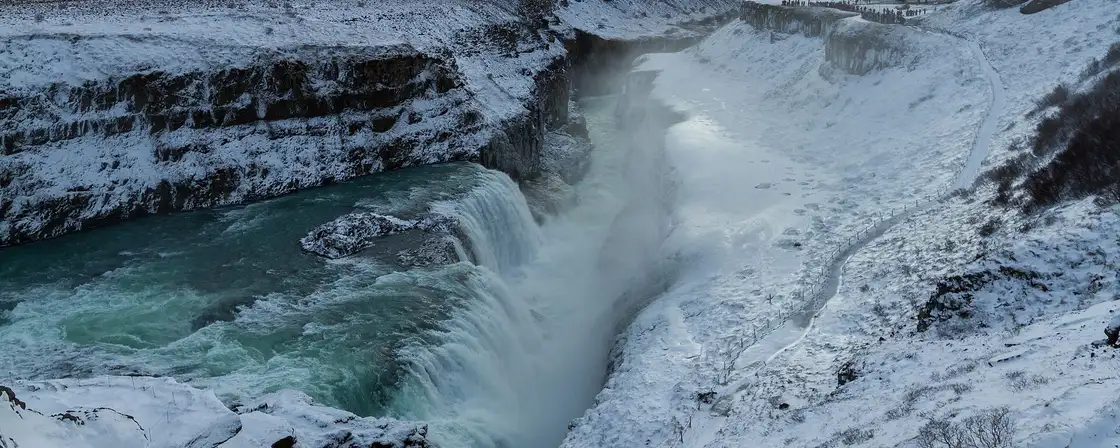
Short days, aurora nights and every ice cave open. It is also the stormiest time: on the day we checked, SafeTravel was warning of gusts up to 35 m/s on the roads east of Reykjavík 10. Keep plans flexible, base yourself in Reykjavík or one south coast town, and book tours with free cancellation.
Spring (March to May)
March is our favourite winter month: still aurora and ice caves, almost 12 hours of daylight and fewer windy days. April brings the end of both seasons and the first puffins; May has 18 hours of light and the start of the Jökulsárlón boats.
Summer (June to August)
The midnight-sun months: about 21 hours of daylight in June, the calmest weather in our data, puffins and whales. There is no aurora to see. The sights are at their busiest; book small groups and lagoon slots ahead.
Autumn (September and October)
The aurora returns in September, whales are still around, and the natural ice caves open on 1 October. Rain days rise, so pack waterproofs.
Plan from here
- Day trips from Reykjavík that fit your month
- Itineraries for 3 to 10 days
- Where to stay by season
Questions people ask
What is the cheapest time to visit Iceland?
There is no official seasonal price index, and tour prices change by date, so compare the exact dates you have in mind. See what a trip costs and compare hotel prices for your dates on where to stay.
What is the best month to see the northern lights?
Any month from September to April with dark, clear nights. February and March combine long nights with more daylight for sightseeing and fewer storms than December and January in our data. Our picks are on northern lights tours.
What is Iceland like in December?
Dark and festive: about 4 hours of daylight around the solstice, aurora and ice-cave season, and frequent storms. The Blue Lagoon closes early on 24 and 31 December. Keep days short and book tours with free cancellation; see day trips.
What is the weather like in Iceland in summer?
Mild rather than warm: around Reykjavík, daytime highs average about 11 to 13 °C from June to August in NASA data for 2016–2025, with the calmest weather of the year. Plan with our itinerary.
Keep planning
- Northern lights toursThe best northern lights tours from Reykjavík compared: small group, budget bus, boat and photo tours, with the season, the forecast and what happens if you see nothing..
- Ice cave toursIceland ice cave tours compared: Katla from Vík (all year), natural blue caves in Vatnajökull (about October to April) and day trips from Reykjavík..
- PuffinsWhen are puffins in Iceland? From late April to mid-August.
- Whale watchingWhale watching in Iceland compared: trips from Reykjavík all year, Húsavík and Akureyri in the north, the best months, the species you see and the no-whale policy..
Sources for this page
- Visit Iceland (Icelandic Tourist Board): “From September to April, Iceland is a hotspot for this magnificent light show.” Checked 25 Nov 2026.
- Arctic Adventures: ice cave FAQ (operator): “For 2026–2027, the Crystal ice cave runs October 1–April 15, while the Skaftafell ice cave runs October 1–April 30. The Neptune ice cave runs October 26–April 15, and the Katla…”Natural-cave dates can change when glacier or weather conditions make access unsuitable. Checked 25 Nov 2026 · secondary source.
- Elding Whale Watching (operator): “observe puffins ... in their natural habitat from late April to mid-August ... Price From ISK 8,300 ... While we don’t land on the islands” Checked 25 Nov 2026.
- Ice Lagoon (Jökulsárlón boat operator): “Opening hours - Tours May: 10am – 5pm June – Sep: 9am – 7pm Oct – 15th of Nov: 10am – 5pm”The operator's pages give slightly different end dates (October or mid-November), so expect the season to end between them, depending on ice and weather. Checked 25 Nov 2026.
- Visit Iceland (Icelandic Tourist Board): “The best time to see whales in Iceland is from April until September when several species of Cetacea are frequently spotted. While whale watching tours are less frequent in the…” Checked 25 Nov 2026.
- Elding Whale Watching (operator): “Season: Season start date 1 Jan to Season end date 31 Dec” Checked 25 Nov 2026.
- Our calculation with NOAA's solar position equations: Daylight in Reykjavík on the 15th of each month: Jan 5 h 21 min, Feb 8 h 34, Mar 11 h 38, Apr 15 h 01, May 18 h 20, Jun 21 h 02, Jul 19 h 48, Aug 16 h 29, Sep 13 h 08, Oct 9 h 54, Nov 6 h 34, Dec 4 h 14. Checked 25 Nov 2026 · our calculation.
- timeanddate.com: “21 Dec: 11:22 / 15:29 / 4:07:10” Checked 25 Nov 2026.
- timeanddate.com: “21 Jun: 02:55 / 00:03 / 21:08:28” Checked 25 Nov 2026.
- SafeTravel (ICE-SAR): “November 26-27, 2026: Strong winds Reykjanes Peninsula, Reykjavík to Vík ... Strong winds 15-25 m/sec with strong wind gusts up to 35 m/sec.”An example of the winter weather that cancels tours and closes roads; read the current alerts on SafeTravel. Checked 25 Nov 2026.